There are a number of camera sensor types available. Below is a table showing their suitablity depending on your scientific /
microscopy application.
Application / Sensor Type
CMOS
CCD
sCMOS
EMCCD
InGaAs
ICCD
Brightfield
•
•
•
•
Low-Light / Fluorescence
•
•
•
•
High Speed
•
•
Infrared / NIR
•
•
•
If you are planning to use the camera on a microscope, there is also the size of the sensor to consider. The main
ones are 1/3″, 1/2″, 2/3″ and 1″. The larger sized sensors generally cost more, but will give you better quality images
since more
light will fall onto the sensor. The other advantage of larger sensors, is that it will give you a bigger field of view. The sensor
under 1″, will typically need additional optics in the microscope coupler, in order to get a similar field of view. The additional
optics are never perfect, and sometimes cause vignetting/shading around the edges.
Filter by manufacturer:
ALL
Sensor type:
ALL
CCD
CMOS
EMCCD
InGaAs/HgCdTe
Intensfied
sCMOS
sCMOS-Back Illuminated
SPAD
BaySpec, Inc., founded in 1999 with 100% manufacturing in the USA (San Jose, California), is a
vertically integrated spectral sensing company. The company designs, manufactures and markets advanced spectral instruments,
including UV-VIS-NIR-SWIR spectrometers, benchtop and portable NIR/SWIR and Raman analyzers, confocal Raman microscopes,
hyperspectral imagers, mass spectrometers, and OEM spectral engines and components, for the R&D, biomedical, pharmaceuticals,
chemical, food, semiconductor, health monitoring, human & animal medical devices, and the optical telecommunications
industries.
BaySpec’s Nunavut™ CCD and InGaAs detectors employ the latest in opto-electrical components to bring you the very best
capability at a very affordable price.
Nunavut™ InGaAs
Nunavut™ series Indium-Gallium-Arsenide (InGaAs) detectors are designed to meet real-world challenges for
best-in-class
performance, long-term reliability, compact size and optimized power consumption.
Covers wavelength ranges 900-1700, 1100-2200, and 1250-2500 nm
Hermetic-sealing ensures reliable operation in harsh environments
Nunavut™ series charge-coupled device (CCD) detectors are designed to meet real-world challenges for best-in-class
performance, long-term reliability, compact size and optimized power consumption.
Covers wavelength ranges 200-1100nm
Real-time data acquisition
Hermetic-sealing ensures reliable operation in harsh environments
The IR-2000 real-time monochrome camera is the next evolution of IR imaging for electrophysiology and other IR applications that require fast response and
excellent sensitivity in both the visible and NIR (up to 1100nm).
The IR-2000 features industry leading frame rates and up to 4K Ultra HD resolution for impeccable image clarity. The user-friendly IR-Capture software provides
increased flexibility and enables users to operate in auto mode or manual mode to achieve the optimal image for any IR application.
Dage-MTI’s 4K-UHD is the ultimate live display microscopy camera for brightfield imaging. The 4K-UHD offers full, ultra high
definition, 3840×2160 output (up to 60fps) with 1600 TV lines of resolution! Small features at low magnification that could not
be resolved satisfactorily using other HD cameras may now be resolved with the Dage 4K-UHD
Like the family of HD cameras Dage offers, the 4K-UHD is preprogrammed for perfect color by critical adjustments of 6 hues – not
just red, green and blue, but yellow, cyan and magenta as well. The 4K-UHD utilizes 3 CMOS chips with pixel offset technology to
increase spatial resolution without sacrificing real time, up to 60fps for live streaming. This fast frame rate enables the
operator to move samples without smear lag or jitter. Real-time, 60fps video streaming also allows effortless focus and specimen
placement for more efficient slide reviews.
The ideal solution for pathology, live cell imaging, and industrial applications.
The HD-310U is an innovative HD brightfield microscopy camera designed for maximum flexibility and ease of use. The HD-310U has a direct HDMI output that
eliminates the need for a computer or it can connect via USB 3.0 for computer imaging (simultaneous viewing of USB & HDMI!).
The HD-310U is pre-programmed for perfect brightfield color by critical adjustments of 12 hues – not just red, green and blue, but yellow, cyan and magenta as
well. The incredibly fast 60fps output enables the operator to move samples or change magnifications without smear lag or jitter and provides effortless focus
for more efficient slide reviews.
greateyes GmbH is an aspiring manufacturer of scientific high-performance cameras for imaging and
spectroscopic applications based in Germany. The company is passionate about innovative, cutting-edge technology and strives for
continuous product improvement. Based on a unique platform concept, customers can choose from a large portfolio of cameras
featuring high dynamic range combined with excellent sensitivities from the X-ray through EUV to the VIS and NIR region.
greateyes offers a series of high-performance, cooled Full-Frame CCD cameras for imaging and spectroscopy in the range from
X-ray to near-infrared (NIR). The cameras combine scientific, highly sensitive CCD sensors and ultra low noise electronics for
optimal detection of weak signals and measurements with high dynamic range. They can be used as detectors for a broad range of
applications in the industrial and scientific community.
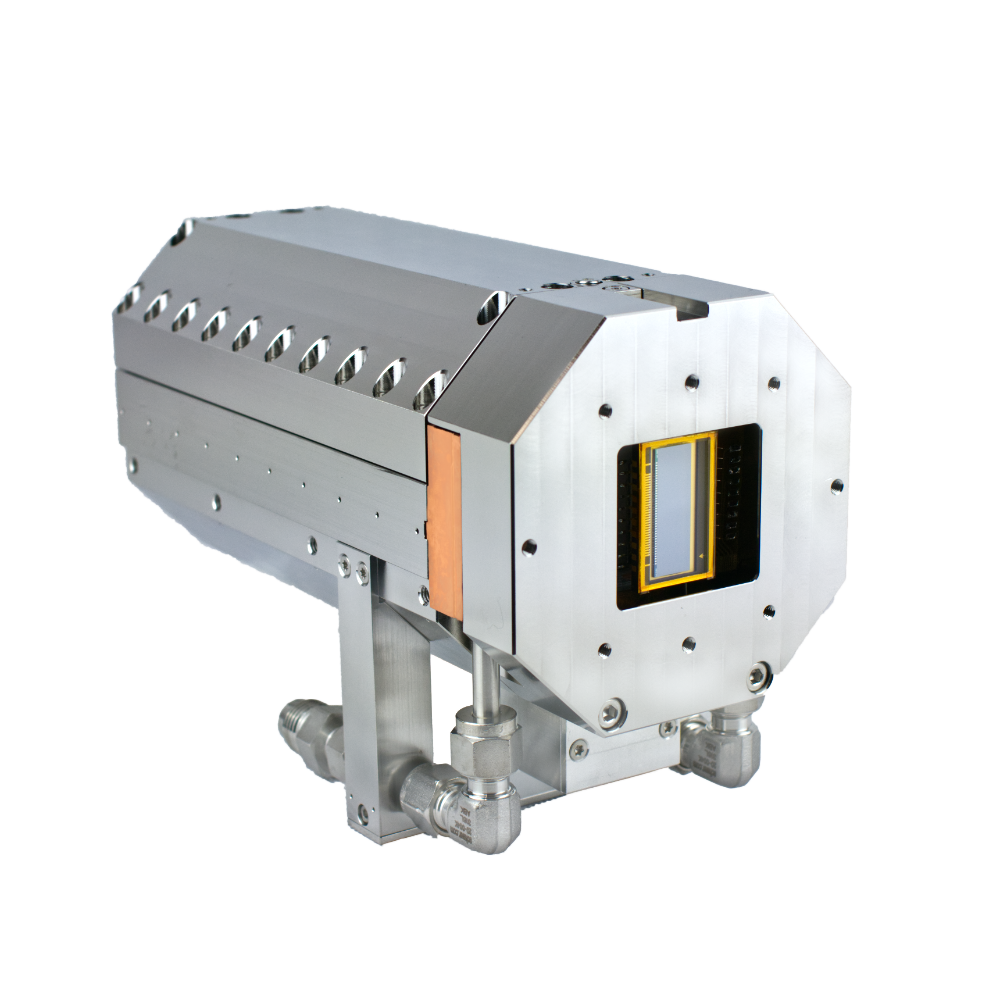
greateyes CHARLIE - State-of-the-art scientific camera with back-illuminated sCMOS sensor
High resolution up to 16.8 Megapixel
CHARLIE, greateyes’ new back-illuminated sCMOS camera that combines cutting-edge technology with innovative functionality, to offer unprecedented
opportunities for the measurements of tomorrow.
Built on our decades of experience in ultra high vacuum (UHV), CHARLIE is specially designed for a broad range of applications in the EUV, VUV and X-ray
range.
With low-noise electronics and deep cooling, CHARLIE delivers peak Quantum Efficiency, high full-well capacity, high dynamic range, and 12-bit SDR and
16-bit HDR modes.
High QE up to 99%, with single photon sensitivity
High frame rates, up to 48 fps (full frame)
Deep cooling to -50°C, with very low dark current for better detection limit and lowest noise
12-bit SDR and 16-bit HDR mode
GigE ∓ USB 3.0 data interface, for local or remote network operation
Compact design, with various flange options, including rotatable
Flexible software options, greateyes Vision software included; and various SDKs and drivers available
Based on a unique platform concept, greateyes offers a portfolio of scientific cameras for imaging and spectroscopy in the UV, VIS and NIR
range. The deep-cooled, high-performance CCD detectors are very compact. They combine highly sensitive sensors with ultra-low noise
18-bit electronics for optimal detection of weak
signals. Select among different pixel formats, several sensor technologies, and various sensor coatings to find the best solution for your
imaging or spectroscopic application.
High performance CCD cameras for high energy or laser plasma applications
Suitable for Photon Energy Range 5 eV - 20 keV
Based on a unique platform concept, greateyes offers a portfolio of scientific cameras with vacuum interface for imaging and spectroscopy in
the VUV, EUV, soft, and hard X-ray range. Incoming photons are directly detected by the CCD sensor. Beside the precise measurement of
high energy radiation, the detectors exhibit a high sensitivity in the ranges NIR, VIS and UV as well.
Innovative in-vacuum cameras with lowest outgassing and ultra low noise performance
Suitable for Photon Energy Range 5 eV - 20 keV
LOTTE is the latest product release from greateyes. Equipped with the most advanced cooling concept we have ever built and driven by the most
powerful and versatile electronic platform this in-vacuum CCD camera is ready to set new standards in its class.
LOTTE utilizes scientific-grade back-illuminated CCD sensors for the detection of EUV, VUV and X-ray signals. The spectral bandwidth covers
photon energies between 5eV and 20keV. The user can also choose from a variety of sensor formats - small to large - with pixel sizes from
13-26µm.
JENOPTIK has a long and successful tradition of developing and manufacturing professional digital cameras.
Since being established from the Carl ZEISS Jena nationally owned collective after German reunification, Jenoptik has
manufactured various imaging systems for space missions and industrial/microscopy applications.
PROGRES GRYPHAX® Series – USB3 for Win,Mac & Linux
Jenoptik equips the JENOPTIK GRYPHAX® series microscope cameras with the latest CMOS technology. Short exposure
times
and high image refresh rates make the system time-saving and convenient to use. This means you can position and focus fast and
easily, even on moving objects.
JENOPTIK GRYPHAX® products are easy to use with any microscope — whatever the brand, thanks to the C-mount interface. No matter if
you work on WIN, MAC or Linux operating systems the software offers you always an identical user interface.
Free updates for the JENOPTIK GRYPHAX® software allow you flexibility and mean you are always kept up-to-date.
Headquartered in Groningen, The Netherlands, Lambert Instruments is dedicated to developing and manufacturing advanced imaging solutions for a
wide
range of applications. They excel in providing solutions for fast events occurring in challenging lighting conditions.
Lambert develop and assemble all products in-house. Together with their software, the products are easy to integrate into your setup. With this,
Lambert
offers customised solutions for your imaging challenges.
Lambert's advanced imaging solutions find applications in many different fields in research and industry.
HiCAM Fluo - Cooled High-speed Camera for Fluorescence Imaging
The HiCAM Fluo is a high-speed camera for fluorescence imaging applications. It records high resolution images at a frame rate of up to 2000 fps
in the most
challenging low-light conditions by using a cooled image intensifier. Packed into a compact aluminum enclosure, it is easy to attach the HiCAM Fluo to any
fluorescence
microscope.
Features
Fiber-optically coupled intensifier
This offers a unique combination of high speed imaging and increased light sensitivity down to single photon level.
CoaXPress
To transfer all the high-resolution image data, the HiCAM Fluo streams live over a CoaXPress (CXP) interface. The camera has four CXP connectors, each of
which
has a channel
speed of 6.25 Gbit/s.
Ultra-Short Gating
With its gated image intensifier, the camera’s effective exposure time can be reduced. The minimum gate width of 10 ns (FWHM) increases the range of light
levels at which the
camera can be used. It also eliminates motion blur and enables time-resolved filtering.
Cooled Image Intensifier
The fanless design of the camera minimises vibrations to ensure sharp images. Very low noise levels are achieved by Peltier cooling the image intensifier.
Noise levels are
reduced by a factor of up to 100 times as compared to uncooled intensified cameras.
HiCAM - Intensified high-speed high-sensitivity imaging camera
The HiCAM is a gated intensified high-speed high-sensitivity imaging camera. It has an integrated fiber-optically coupled image intensifier,
which offers a
unique combination of
high speed and sensitivity down to single photon level. Because the HiCAM does not need high intensity light sources, it is suitable for use in low-light level
conditions.
Applications
Super-slow motion combustion research for the automotive industry
Time-resolved imaging in plasma physics research
Dynamic phenomena in microscopy, e.g. Imaging the rotation of single molecules of ATPase
Laser-Induced Fluorescence (LIF)
Flow visualization and velocity measurements using Particle Image Velocimetry (PIV)
Time-resolved imaging of fluids for microfluidic research
TRiCAM - Intensified low-light imaging camera with ultra-short gating
The TRiCAM is a compact intensified low-light imaging camera. It is designed for scientific and industrial applications that require low-light
imaging. With
built-in signal generators, the TRiCAM is capable of ultra-short exposures through fast gating and therefore suitable for time-resolved imaging..
Features
Gated image intensifier
The TRiCAM is equipped with an integrated timing pulse generator and a gate-unit, generating gate pulses down to < 3 ns.
Low-light imaging
The TRiCAM has a built-in image intensifier that boosts the incoming light. This way, you can capture detailed images in the most challenging light
conditions.
Fiber-optically coupled
The sensor is couple to the image intensifier with a fiber-optic plate, resulting in a 10 – 20x more light efficient system. The fiber-optic plate is a
solid
piece of glass
thatconsists of millions of parallel glass fibers sealed together. Each fiber acts as an independent light conductor that transfers the light from the image
intensifier to
the sensor.
Mightex Systems, with operations based in Toronto, Canada, and in the Silicon Valley, California, is a leading
supplier of photonic products and services for a broad spectrum of applications including industrial imaging, bio-photonic
solutions, LED illumination, machine vision, life & health sciences, and industrial test & measurement etc.
Mightex has developed a range of SuperSpeed USB3.0 and USB2.0 digital cameras, which are compatible with all the
major brands of microscopes including Leica, Nikon, Olympus and Zeiss. Camera software is included with the camera purchase, free
of charge. In addition, these cameras are also compatible with ImageJ through TWAIN (included, free of charge).
Nüvü Cameras are industry leaders in designing sensitive EMCCD cameras, achieving new standards of SNR for low
light imaging with their innovative technology. Their patented CCCP Controller delivers unprecedented levels of EM gain by
minimizing the presence of clock-induced charge (CIC), and this allows for sub-electron read-out noise and ultra-high horizontal
charge transfer efficiency for clearer images. These cameras are built for easy integration as they compact and user-friendly.
Nüvü™ reinvents the electronics behind the EMCCD Camera
HNu offers a high quality, thermoelectrically-cooled EMCCD camera with a maximum EM gain of 5000, a total noise
floor down to 0.001 e/pixel/frame and acquisition rates up to 20 MHz in full frame. Nüvü’s HNu EMCCD camera integrates the
patented CCCP Controller to minimize the clock-induced charges involved in counting photons and is optimized for low light
imaging. The camera supports three standard EMCCD detector sizes (128 × 128, 512 × 512 and 1024 × 1024). Fields of application
include Fluorescence and Bioluminescence, Spectroscopy, Super Resolution, OEM and Astronomy.
16 Bits
1 – 5,000 Electron Multiplying gain
Cooling temperature down to -90°C via liquid cooling (-85°C via air cooling),stabilized (± 0.01 °C)
EM N2 EMCCD Camera – Back illuminated, Liquid Nitrogen Cooled
The EM N2 EMCCD Camera delivers high SNR for a variety of low light applications
The EM N2 is a state-of-the-heart, liquid nitrogen cooled EMCCD camera. The EM N2 EMCCD camera supports three
standard EMCCD detector sizes including 128 × 128, 512 × 512 and 1024 × 1024, in addition to custom sizes for specific
requirements. Its detector can be cooled down to -110°C for applications that require extremely low thermal noise, particularly
during long exposures. It can also achieve 1,004 fps, in full frame, at a 20 MHz readout rate. EM N2 offers EM gains of up to
5000 EM, whilst minimizing the total noise floor down to 0.001 e/pixel/frame. It employs Nüvü Cameras’ patented CCCP technology
in order to ensure the lowest clock-induced charge (CIC) levels.
16 Bits
1 – 5,000 Electron Multiplying gain
Cooling temperature down to -110°C, stabilized (± 0.01 °C)
PCO develop and produce specialized fast and sensitive video camera systems, mainly for scientific applications. The product
range of PCO cameras covers digital camera systems with high dynamic range, high resolution, high speed and low noise, which are
sold in the scientific and industrial market all over the world.
The pco.edge family of sCMOS cameras features an excellent combination of high resolution, high quantum
efficiency, high frame rates and high dynamic range. All pco.edge cameras are available with various interface options.
pco.edge 26 USB sCMOS Camera
Excelitas pco.edge 26 USB sCMOS camera features a 5120 x 5120 pixel resolution with 2.5 x 2.5 µm pixel size to achieve highest spatial resolution
critical for imaging in microscopy, quality control, high throughput screening, and other mesoscopic applications. The pco.edge 26 camera also offers
optimal performance for microscopy imaging with low magnification. In addition, its true charge domain global shutter allows for an exceptionally low
readout noise and dark current. Combined with its adjustable cooling feature, the pco.edge 26 allows extended exposure times of up to 60 seconds.
The pco.edge 26 DS CLHS offers high-speed, high-resolution streaming by combining the image quality of a charge domain global shutter 26 MPixel image
sensor with fast and efficient data transfer. Its double shutter mode enables an interframing time of 350 ns, ideal for capturing fast dynamic processes.
This advanced camera is perfect for applications requiring exceptional detail and speed such as in Particle Image Velocimetry (PIV) applications.
The Excelitas pco.edge 26 CLHS offers high-speed, high resolution streaming by combining the image quality of a 26 MPixel image sensor with unrivaled
data transfer options. It features four CLHS Fiber Optic Link (FOL) channels - all aligned in one compact plug - which can be selected from one to four
sequentially with the ability to transmit up to 3.93 Gpixel/s. Furthermore, the pco.edge 26 CLHS camera operates at a minimum read noise and dark current
without compromising image quality, thus making this CMOS camera a powerful solution for numerous applications in life science and physical science.
The pco.edge 10 bi LT is Excelitas' next-level sCMOS camera with new imaging performance. With a back-illuminated image sensor, the pco.edge 10 bi LT
provides a
quantum efficiency of up to 85 % with a broad spectrum extending to NIR. The sensor incorporates microlenses and a full-depth deep-trench isolation for
crosstalk suppression resulting in an excellent MTF. Furthermore, the camera provides a large image circle by using a high-resolution 10.46 MPixel image
sensor with a square pixel size of 4.6 μm.
The pco.edge 10 bi CLHS is their next-level sCMOS camera designed to deliver exceptional imaging performance suitable for microscopy, life science and
physical science applications. With a back-illuminated image sensor, the pco.edge 10 bi CLHS comes with a quantum efficiency of up to 85 % with broad
spectrum out to NIR. The sensor incorporates microlenses and a full-pixel height deep trench isolation for suppressing crosstalk and achieving excellent
modulation transfer function for highest image quality.
The pco.edge 9.4 bi CLHS is Excelitas' first sCMOS camera with photon counting capabilities for challenging and demanding microscope methods like
Lightsheet
Fluorescence Microscopy (LSFM) and Structured Illumination Microscopy (SIM). This sCMOS camera combines an extremely low readout noise of 0.3 e- with a
quantum efficiency of up to 85% with a broad spectrum out to NIR. The sensor incorporates microlenses and a full pixel height deep trench isolation for
crosstalk suppression, resulting in an excellent modulation transfer function. The camera provides a large image circle using a high-resolution 9.4MPixel
image sensor with a square pixel size of 4.6µm. The camera is equipped with four CLHS FOL channels – all aligned in one compact plug – capable of
transmitting up to 4.9 GByte/s.
The pco.edge 5.5 USB camera is equipped with a well-established scientific CMOS (sCMOS) sensor that provides crisp images and precise measurements. The
pco.edge 5.5 sCMOS camera features an option to upgrade with a water-cooling system and is ideally suited for applications that require high resolution,
high frame rates, best 16-bit dynamic range, selectable shutter variants and an optional color sensor.
The pco.edge 5.5 DS CLHS camera features a high resolution of 5.5 MPixel and operates in 16-bit mode for precise imaging. Its double shutter mode enables
an interframing time of just 100 ns, ideal for capturing fast dynamic processes. This advanced camera is perfect for applications requiring exceptional
detail and speed, such as in Particle Image Velocimetry (PIV) applications
The pco.edge 5.5 is a high resolution cooled sCMOS camera utilizing a CLHS interface and 10G FOL (Camera Link HS) to allow direct processing of large
data transfers via a computer making it easy to securely bridge distances of up to 10 km. This camera is equipped with a 16-bit scientific CMOS sensor
for capturing crisp images and precise measurements. The pco.edge 5.5 camera also comes with an option to upgrade with a water cooling system.
The pco.edge 4.2 USB scientific camera is equipped with an innovative scientific CMOS (sCMOS) sensor that allows exceptional image quality and precise
measurements. With the ability to capture crisp images, the pco.edge 4.2 USB sCMOS camera system is ideal for applications requiring highest quantum
efficiency, best 16-bit dynamic range, high frame rates, long exposure times, and extremely low readout noise.
lowest readout noise of 0.8 e- med
high resolution of 2048 x 2048 pixel
dynamic range of 40 000 : 1 (USB) / 35 500: 1 (CL)
The pco.edge 4.2 LT scientific camera features a scientific CMOS (sCMOS) sensor to achieve crisp images and precise measurements. With 2048 x 2048 pixel
high resolution and 6.5 µm pixel size, this sCMOS camera is most suitable for users who require highest quantum efficiency, best 16-bit dynamic range,
and extremely low readout noise.
The pco.edge 4.2 is a high resolution, cooled sCMOS camera that operates with streaming via a 10G FOL (Camera Link HS) to allow direct processing of
large data transfers through its high-performance data interface making it easy to securely bridge distances of up to 10 km. The pco.edge 4.2 is equipped
with a low noise 16-bit scientific CMOS sensor to ensure crisp images and precise measurements. The pco.edge 4.2 sCMOS camera also comes with an upgrade
option to include a water cooling system.
The pco.edge 4.2 bi XU features a back-illuminated sCMOS sensor with extremely specific coating ideally suited for use in applications in the visible
light down to extreme UV (EUV) and soft X-ray radiation. Featuring 2048 x 2048 pixel resolution and 6.5 μm pixel size, the pco.edge 4.2 bi XU allows full
frame acquisitions at 40 fps with a dynamic range of 88 dB at a noise level of 1.9 e-.
The pco.edge 4.2 bi UV is built on the trusted pco.edge series of scientific CMOS cameras with modern back-illuminated sensor technology. It offers a
2048 x 2048 pixel high resolution and 6.5 x 6.5 μm² pixel size for high quality imaging. Featuring a specialized input window, this UV sensitive sCMOS
camera can achieve high quantum efficiency in the ultraviolet wavelength range.
The pco.edge 4.2 bi sCMOS camera features back-illuminated sensor technology with a quantum efficiency of up to 95 %. This compact sCMOS camera achieves
the highest image quality with a resolution of 2048 x 2048 pixels and a pixel size of 6.5 μm. Its adjustable cooling system offers flexibility in the use
of either air or water to cool the sensor down to -25 °C and reduce dark current to 0.2 e-/pixel/s for maximum imaging performance. The pco.edge 4.2 bi
camera comes with an input window available for either UV or VIS wavelength ranges to best suit your application.
The pco.edge 3.1 USB camera is equipped with an innovative scientific CMOS sensor to achieve crisp images and precise measurements. This camera features
a high-resolution of 2048 x 1536 pixels, high frame rates, best 16-bit dynamic range, selectable shutter variants and an optional color sensor.
Furthermore, the pco.edge 3.1 features outstanding low read-out noise of 1.1 electrons median even at the maximum speed of 50 fps at full resolution for
superior image quality.
The pco.panda series represents our product family of uncooled compact scientific CMOS (sCMOS) cameras. These cameras feature optimized passive thermal
management housing to enable high sCMOS image sensor performance in the most compact form factor. Furthermore, additional optional features such as low light
mode, light sheet scanning mode, or double shutter technology are available to enhance the cameras’ performance further for greater versatility.
pco.panda 26 sCMOS Camera
The ultra-compact pco.panda 26 scientific CMOS (sCMOS) camera provides high resolution of 5120 x 5120 pixels. It is available in monochrome and color
sensor options, making it ideal for various scientific applications. Featuring 2.5 x 2.5 µm pixel size, the pco.panda 26 is an excellent fit for optical
systems such as microscopes, even with low magnification.
Our pco.panda 26 DS is an ultra-compact sCMOS camera with 5120 x 5120 pixel resolution designed for particle image velocimetry (PIV) applications.
Featuring outstanding double shutter capabilities, the pco.panda 26 DS is the perfect camera solution for performing effective double imaging – essential
for PIV measurements in flow analysis. The pco.panda 26 DS camera features a small 2.5 x 2.5 µm pixel size with a resolution capacity well-suited for use
in optical systems.
Excelitas pco.panda 4.2 is a scientific CMOS camera which features a 16-bit sCMOS sensor. It offers a high resolution of 2048 x 2048 pixels with 6.5 x
6.5 μm pixel size to ensure excellent image quality. Its ultra-compact camera housing and flexible design with the latest sCMOS technology makes the
pco.panda 4.2 ideal for use in a wide range of applications.
Featuring sCMOS technology, the pco.panda 4.2 bi is a back-illuminated camera with a quantum efficiency of up to 95 % making this camera perfectly suited
for demanding low-light imaging without the need for active cooling. With a sCMOS sensor of 2048 x 2048 pixels and a 6.5 x 6.5 μm pixel size, our
ultra-compact pco.panda 4.2 bi provides greater detail for highly qualitative images.
Excelitas pco.panda 4.2 bi UV is an ultra-compact, back-illuminated scientific CMOS camera with high resolution from UV to VIS. Featuring 2048 x 2048
pixels resolution and 6.5 x 6.5 μm pixel size, the pco.panda 4.2 bi UV ensures greater detail diversity and highly qualitative images. With a specialized
input window, the pco.panda 4.2 bi UV achieves a high quantum efficiency of up to 90 % in the ultraviolet wavelength range. This camera is perfectly
suited for applications with demanding lighting conditions without the need for active cooling.
The Excelitas pco.pixelfly™ 1.3 SWIR is a high-performance machine vision camera due to its special InGaAs image sensor which is sensitive in the shortwave
infrared (SWIR), near infrared and visible range of the electromagnetic spectrum. It shows a favorably high sensitivity in the whole spectral range with up to
90
% in the shortwave infrared band. The small pixels enable the use of small magnification optics in microscopy and a low dark current for long exposure times.
High Sensitivity
The pco.pixelfly 1.3 SWIR camera is highly sensitive to shortwave infrared light, making it ideal for use in low-light or challenging imaging environments.
The camera can capture high-quality images even in situations where both, visible light as well as near-infrared light, are required for the
application.
Wide Spectral Range
VIS & SWIR cameras have a wide spectral range, typically between wavelengths of 400 and 1700 nanometers, allowing them to capture a wide range of
information and detail in this broad band of the light spectrum.
Robust Design
Designed to withstand the harsh environments often encountered in industrial and scientific applications, the pco.pixelfly 1.3 SWIR camera is durable,
reliable and long-lasting, making it an ideal choice for demanding imaging applications.
High Resolution
This high-resolution imaging camera offers the ability to capture clear and detailed images in even the most challenging of environments making it suitable
for applications such as industrial inspection, material analysis, and scientific research.
Versatile
The pco.pixelfly 1.3 SWIR camera can be used in a wide range of applications, from low-light imaging to industrial inspection, material analysis, and
scientific research. With the ability to operate effectively in challenging environments and capture detailed images in the short-wave infrared spectrum,
this
versatile camera is a valuable tool for many industrial applications.
The Excelitas pco.flim X camera system consists of the pco.flim camera and pco.flim laser, with a complete frequency synthesizer, which is required
for
the generation of the modulation signals in the frequency domain. The pco.flim series features a high frequency modulated CMOS image sensor that
enables pixel-wise measurements of sample luminescence lifetime distributions in frequency domain suitable for fluorescence lifetime imaging. At a
maximum speed of 10 Hz, full luminescence lifetime distributions can be measured at 1 Mpixel resolution. With flexible coupling and easy setup,
the pco.flim is an ideal choice for wide-field FD-FLIM instruments and suitable for a variety of biomedical applications requiring a large frame
and
high-speed acquisition.
The pco.flim X is a new version of the first frequency domain (FD) FLIM camera using a fast modulatable CMOS sensor with two readout-taps per
pixel.
It offers an improved cooling, which achieves -5°C with forced air cooling and -20°C image sensor temperature with water cooling. All of this
reduces
the readout noise level below 15 [e-] and extending the usable exposure times to 4 instead of 2s. Therefore the pco.flim X remains the frequency
domain FLIM camera system with the largest resolution of 1008 x 1008 pixel and the highest maximum frame rate of 45 double images/s on the market.
Excellent resolution of 1008 x 1008 pixels
Can measure fluorescence lifetimes from 1 ns – 100 µs
Image sensor thermoelectrically cooled down to -5°C (air) / -20 °C (water)
Maximum frame rate of 45 double images/s at full resolution
Excelitas pco.dimax cs high-speed cameras are specifically designed for harsh and demanding applications in car safety. With very high frame rates at a
resolution of up to 4 megapixels, the pco.dimax cs camera series provide magnificent light sensitivity, leading image quality and excellent color rendering.
Designed with a compact, lightweight and rugged design, these high-speed cameras are able to withstand harsh and demanding conditions such as crash tests for
both on-board and off-board use
Available in three different models with different resolutions, the pco.dimax cs high-speed cameras offer secure trigger and synchronization modes, excellent
light sensitivity, automatic image calibration, an HD-SDI output, integrated lens control, and a quick-change lens adapter. These features make the pco.dimax
cs camera series ideally suited for a variety car safety applications such as airbag behavior analysis, automotive component testing, crash and sledge testing,
hyper velocity impact studies, fuel injection analysis, spray imaging analysis, material and tensile strength testing, and automotive component testing.
compact & ruggedized
pco.dimax 3.6 ST
This versatile high-speed camera is known for its outstanding image quality and speed. It captures over 2,000 frames per second (fps) at a full
resolution of 3.6 MPixel. Its Camera Link HS data interface (CLHS FOL) guarantees real-time, uncompressed, robust 10-bit data transmission over 8x10Gb
optical fiber, maintaining lossless image details.
Designed for applications that demand both high speed and high resolution, it provides fast frame rates of up to 3,086 fps at a high resolution of 1296 x
1024 pixels. The pco.dimax cs1 features intuitive control software, multiple lens mounts (including electronic lens control), HD-SDI video output, and
automatic image calibration.
Offering a balance of speed and resolution, the pco.dimax cs3 captures high-speed events with frame rates of up to 1,603 fps at a high resolution of 1920
x 1440 pixels. It features intuitive control software, multiple lens mounts (including electronic lens control), HD-SDI video output, and automatic image
calibration.
Designed for ultra-high-speed imaging, the pco.dimax cs4 captures up to 1,102 fps at a high resolution of 2016 x 2016 pixels. It offers excellent light
sensitivity, image quality, and color rendering features. The camera features intuitive control software, multiple lens mounts (including electronic lens
control), HD-SDI video output, and automatic image calibration.
MCP Image Intensifier Based Camera Systems for Short Exposure Applications
The family of MCP image intensifier camera systems offers extremely short exposure/shutter times down to 4 ns. The appropriate
spectral behaviour can be selected by the photocathode material of the MCP tube
The Excelitas pco.dicam C4 LX four-channel intensified camera, based on a 25mm image intensifier, is a budget friendly, easy-to-use alternative to the
high-end versions. Built on our established pco.dicam C4 hardware platform, the pco.dicam C4 LX gives you full access to the world of true optical gated
imaging. With no export restrictions and intuitive software, the S20-photocathode matches most application requirements.
The Excelitas pco.dicam C8 LX eight-channel intensified camera, based on a 25mm image intensifier, is a budget friendly, easy-to-use alternative to the
high-end versions. Built on our established pco.dicam C8 hardware platform, the pco.dicam C8 LX gives you full access to the world of true optical gated
imaging. With no export restrictions and intuitive software, the S20-photocathode matches most application requirements.
Photon etc. aims to provide each researcher, engineer and technician with access to the latest innovations in optical and
photonic instrumentation. As pioneers in Bragg-based hyperspectral imaging, they offer state-of-the-art instruments, driven by
our client’s desires to surpass limitations in measurement and analysis.
Inspired by the scientific creativity found in Montreal and Quebec, they promote open and collaborative innovation and
excellence.
SWIR Cameras – Fast and Low Noise InGaAs and HgCdTe Cameras
Extending the boundaries of industrial imaging, Photon Etc. has developed affordable SWIR cameras sensitive from
800 nm to 2.9 µm. Using a sensitive InGaAs or HgCdTe (MCT) FPA, ZEPHIR™ collects images at an astounding 340 frame-per-second
rate while reaching unrivalled low noise levels with the integration of a four-stage TE cooler. Their BOREA™ line uses a Stirling
micro cooler and has lower noise levels than its TE cooled competitors. Initially designed for demanding faint flux applications
such as hyperspectral imaging, their cameras are well-suited for spectroscopy, astronomy or industrial applications in quality
control and sorting.
ZEPHIR 1.7
The ZephIR 1.7 is a high-end, scientific-grade InGaAs camera that combines performance with reliability. It has extremely low noise levels, high
efficiency, and a rapid frame rate compatible with an external trigger. This is made possible by combining their state-of-the-art control electronics and
a
four-stage thermoelectric cooler (TEC) which can maintain an operating temperature as low as -80 °C. The TEC uses forced air cooling that alleviates the
need for a water or liquid nitrogen chiller unit, increasing reliability and is designed to last for years.
The ZephIR 1.7 stands out as one of the market's most reliable SWIR InGaAs cameras, boasting an exceptional sensitivity level, all while offering a
high-end experience that remains affordable.
The ZephIR 2.5e is an affordable deep-cooled, SWIR camera, sensitive from 1100 to 2500 nm. By deep-cooling the infrared sensor, the ZephIR 2.5e is able
to acquire more signals and minimize unwanted noise for a given imaging application. The extended spectral range offers scientists and engineers the
possibility of acquiring a signal covering a broader wavelength spectrum, which in turn helps build better infrared detection systems. By using
thermoelectric cooling, the ZephIR 2.5e doesn’t require any maintenance from a water or a liquid nitrogen chilled unit and does not suffer from the
limited lifetime of Stirling mechanical coolers. This leads to greater usability and flexibility when integrating ZephIR 2.5e cameras in your own
systems.
With high frame rates allowing high speed image acquisitions through USB 3.0 or cameralink, the ZephIR 2.5e is tailored for demanding industrial
applications or high precision scientific experiments. Users can also choose to use Photon etc’s PHySpec camera control software or develop their own
using a Python or C++ software development kit (SDK).
The Alizé 1.7 is a high-end, scientific grade, 640 x 512 pixels resolution, InGaAs camera that marries performance with reliability. It has low noise
levels, high efficiency, and a rapid frame rate compatible with an external trigger. This is made possible by a combination of state-of-the-art control
electronics and a four stage thermoelectric cooler (TE) which can maintain an operating temperature as low as -60 °C. The cooler uses forced air cooling
which requires none of the maintenance of a water or liquid nitrogen cooled unit.
The Alizé 1.7 is amongst the most cost-effective high-end InGaAs cameras on the market.
The HypIRia are wide-aperture, image-space telecentric lenses precisely crafted to provide clear and bright images in the SWIR spectral range. A
broadband anti-reflective coating on carefully selected glass delivers high throughput and low-aberration imaging on a range extending from 1.0 to 2.9
µm.
A translational focus provides excellent stability during focusing. Robustly built, they are well suited for industrial applications or field work.
Pi Imaging Technology are based in Lausanne, Switzerland. They are changing the way we detect light with photon-counting arrays with extremely high sensitivity
and low noise.
The technology is based on single-photon avalanche diodes (SPADs) designed and manufactured in standard semiconductor flows. This enables photon-counting
arrays
with megapixel resolution and adaptable architectures.
Light is both a wave and a particle. When observed as a particle, light is quantized, or digitalized. Pi Imaging's detection technology, based on single-photon
avalanche diodes (SPADs) transforms light directly into a digital signal, thus not altering its original (digital) state.
This direct photon to digital transformation enables unprecedented image quality and detection speed. Our cutting-edge solutions offer unparalleled sensitivity
and minimal noise, setting new standards in the industry.
SPAD Alpha is a photon-counting camera for high-speed imaging. The core of the camera is a SPAD image sensor with 1024×1024 pixels. Photon counting with
up to 73’000 frames per second and zero readout noise is achieved. The global shutter enables nanosecond exposures with exposure shifts of 17 ps. The
image sensor is optimized for low noise, with a typical dark count rate of less than 100 cps.
Widefield camera
Released in 2025, SPAD Alpha is the successor of the first commercially available SPAD camera in the world, SPAD 512. It is suitable for
photon-counting and photon-time gating applications.
Imaging in color
Their single-photon detectors are fabricated with RGB filters allowing for photon counting in color.
Time gating
The sensor features time gating to study time varying signals of interest, such as FLIM. This makes it a perfect addition to any widefield FLIM
microscopy setup.
Plug and Play
The system requires just a 5V power adapter and two USB3 cables to run. For full flexibility, 2 additional control lines can be connected to the SMA
connectors.
SPAD512 is a camera integrating a 512×512 SPAD image sensor. Up to 100,000 fps in 1-bit mode enable high-speed imaging
(photon-counting). Fine time gating enables the study of time-varying samples.
Widefield camera
Released in 2021, SPAD512 is the first commercially available SPAD camera in the world. The camera features a 512×512
SPAD image sensor for both photon-counting and photon-time gating applications. This camera is ideal to replace scientific CMOS and CCD cameras in
widefield microscopy and high-speed imaging applications.
Wide detection spectra and low noise
Their single-photon detectors are fabricated in a state-of-the-art CMOS process and offer an ultra-low
dark count rate of less than 25 cps. Microlenses enhance the sensor's detection efficiency.
Time gating
The sensor features time gating to study time varying signals of interest, such as FLIM. This makes it a perfect addition to
any widefield FLIM microscopy setup.
Plug and Play
The system requires just a 5V power adapter and two USB3 cables to run. For full flexibility, 2 additional control lines
can be connected to the SMA connectors. The industry standard C/CS-mount optical port and the M4 screw mounting positions offer a flexible integration
into any existing optical setup.
A point detector built around a single-photon avalanche diode (SPAD) array with 23 or 93 pixels packed in a hexagonal configuration. This detector is a perfect
complement for any confocal scanning microscope; it delivers individual photon time of arrivals and enables super-resolution microscopy.
SPAD 93 / SPAD 93G
SPAD 93 is a detector array with 93 hexagonally packed single-photon avalanche diodes (SPADs) with best-in-class performance. It features both the
capability of direct photon-counting and photon-time tagging to enable a wide range of single-photon detection applications.
Ideal point detector
SPAD 93 is the ideal solution for a confocal scanning setup. Each pixel can act as a virtual pinhole, increasing resolution and contrast.
Wide detection spectra and low noise
Their single-photon detectors are fabricated in a state-of-the-art CMOS process and offer an ultra-low dark count rate of less than 100 cps.
Microlenses enhance the detection with a peak sensitivity of over 45%
High timing resolution
Real-time processing of photon events occurs in a field-programmable gate array. The detector can process up to 2.3 Gcps over the whole array.
Time-to-digital converters per pixel enable a fine timing resolution down to 20 ps with at a maximum photon flux of 70 Mcps.
Plug and Play
The system requires just a 5V power adapter and USB3 cable to run. For full flexibility, 4 additional control lines can be connected to the SMA
connectors. The SM1 optical port, the M2.5 and the M4 screw mounting positions offer a flexible integration into an existing optical setup.
SPAD23 offers two distinct flavours with a spectral range peaking either in the green or the red. SPAD23G is a detector array with 23
hexagonally
packed single-photon avalanche diodes (SPADs) with best-in-class performance in the green wavelengths (peaking at 520nm). SPAD23R is a detector with a
5×5
pixel
array optimized for red wavelengths (peaking at 620nm). Both systems feature the capability of direct photon-counting and photon-time tagging to enable a
wide
range of single-photon detection applications.
Ideal point detector
SPAD23 is the ideal solution for a confocal scanning setup. Each pixel can act as a virtual pinhole, increasing resolution and
contrast.
Wide detection spectra and low noise
Their single-photon detectors are fabricated in a state-of-the-art CMOS process and offer an ultra-low
dark count rate of less than 100 cps. Microlenses enhance the detection with a peak detection efficiency of over 45%.
High timing resolution
Real-time processing of photon events occurs in a field-programmable gate array. The detector can process up to
180 Mcps over the whole array. Time-to-digital converters per pixel enable a fine timing resolution down to 20 ps with at a maximum photon flux of 70
Mcps.
Plug and Play
The system requires just a 5V power adapter and USB3 cable to run. For full flexibility, 4 additional control lines can be
connected to the SMA connectors. The SM1 optical port, the M2.5 and the M4 screw mounting positions offer a flexible integration into an existing
optical
setup.
SPADλ is a linear detector with a 320×1 SPAD array. It features single-photon detectors (SPADs) enabling both photon-counting and photon-time
tagging. This arrangement is ideal for spectral detection applications. Thanks to microlenses and state-of-the-art production facilities, this detector offers
high detection efficiency. The detector is capable of both time gating and time stamping for the ultimate control over time-varying signals of interest..
Linear detector array
SPADλ features a single line with 320 single-photon detectors. This form factor is suitable for spectral
applications that require high-speed, low light performance and/or single photon timing.
Wide detection spectra and low noise
Their single-photon detectors are fabricated in a state-of-the-art CMOS process and offer a low dark
count rate of less than 250 cps. Microlenses enhance the detection with a peak detection efficiency of over 45%.
Time tagging * and gating
The sensor features both time tagging and time gating to study time varying signals of interest, this offers
the most flexible approach to filter out unwanted signal while still preserving the arrival information of single-photons.
Plug and Play
The system requires just a 5V power adapter and two USB3 cables to run. For full flexibility, 4 additional control lines can be
connected to the SMA connectors. The industry standard C/CS-mount optical port and the M4 screw mounting positions offer a flexible integration into any
existing optical setup.
PixeLINK® is a global provider of industrial cameras for the machine vision and life sciences markets. Since 1992,
PixeLINK® has designed, manufactured and supported the hardware and software requirements of machine vision, OEM and
microscopy customers around the world. Offering unmatched customer support and service, PixeLINK® designs and manufactures
reliable industrial cameras and microscope cameras for any machine vision project or microscopy application.
Located in Ottawa, ON, Canada, Pixelink has been a part of Navitar since 2017.
Pixelink USB 3.0, USB 2.0 and FireWire microscopy cameras are designed to offer consistent, high-quality image acquisition and
performance. Ideal for
use in any laboratory setting, their USB 3.0 cameras let you capture high-quality imagery with your existing microscope equipment
Pixelink microscopy cameras provide high-resolution imaging capability for both bright field and dark field microscopy in addition to offering
excellent color reproduction. Their USB 3.0 cameras offer resolutions of 1 to 20 Megapixels, fast frame rates and high resolution. Offering both
global
and rolling shutter sensor options and the ability to specify a region of interest, their cameras are ideal for a number of applications that
include
histology, pathology, hematology, materials science, semiconductor inspection, metrology, documentation & archiving, and more.
Pixelink® also offers camera software that includes annotation and measurement tools and allows you to manage and archive captured images.
Designed to offer consistent, high-quality image acquisition and performance, and backed by industry leading customer support, Pixelink M-Series
cameras combine large field of view, high speed live previews, simple sample manipulation and superb color reproduction.
High-Resolution Imaging for Laboratory Use
Ideal for Bright Field and Dark Field Microscopy
High Quality Image Acquisition
Excellent Color Reproduction
2 Megapixel to 20 Megapixel Resolutions
µScope Microscopy Software Suite Available
Ideal for use in any laboratory setting, PixeLINK Life Science Cameras let you capture high-quality imagery with
your existing microscope equipment. Their Life Science cameras are designed to offer consistent, high-quality image acquisition
and performance.
Pixelink offers a range of CCD and CMOS camera for microscopy.
SPOT Imaging Solutions ( a division of Diagnostic Instruments, Inc.) manufactures scientific CCD and CMOS digital cameras,
imaging software, macro imaging stands, camera adapters,and stereo microscope support stands.
SPOT Imaging Solutions was founded in 1967 and is headquartered in Sterling Heights, Michigan, USA.
SPOT Imaging manufactures a complete line of scientific digital cameras for microscopy, from easy to use color
CMOS cameras for brightfield microscopy to ultra-sensitive scientific CMOS sensors for low light fluorescence applications.
Every SPOT camera comes with the SPOT Software™, an easy to use image capture application full of tools for microscopists,
including scale bar, annotations, measurements, custom reporting, and time-lapse recordings. Cameras run on both Windows® and
Macintosh® computers, and a Software Development Kit is available for integration with custom software. All SPOT cameras ship
with a 2-year manufacturer’s warranty and their exceptional track record for building reliable cameras that last for years.
The SPOT RT sCMOS uses Sony’s breakthrough Pregius™ CMOS sensor. Now you can experience unprecedented speed and
sensitivity in a scientific CMOS camera. Deep cooling allows dim images to be seen without becoming obscured by dark current
Teledyne Lumenera,headquartered in Ottawa, Canada, is a leading developer and manufacturer of high performance digital
cameras and custom/OEM solutions. Lumenera cameras are used worldwide in a wide range of industrial, microscopy, surveillance,
and astro applications.
Lumenera’s solutions provide unique combinations of speed, resolution and sensitivity to satisfy the most demanding
digital imaging requirements. The company’s core competencies include digital bus technologies such as USB 3.0, USB 2.0,
HDMI, Ethernet and GigE as well as the integration of CMOS and CCD sensors.
Teledyne Lumenera leverages its leading edge technology to provide customized design services,continuous innovation and licensing options
to OEM partners.
Whether you are shopping for the best price-to-performance microscopy camera to include with your new microscope setup, or you are looking to
retrofit and older
microscope to make
it useful again, there is just the right INFINITY microscopy camera to meet your needs. Using the latest in advanced sensor technology, INFINITY monochrome
microscopy cameras
address the needs of fluorescence imaging and produce multi-layer florescence in a single vivid color. While the color models produce multi-color images, both
can be used in
education and lab settings.
The INFINITY microscope camera body provides a heat-dissipating design that reduces noise without the need for costly fans or cooling systems, and INFINITY
microscope cameras
are
compatible with most c-mount microscopes.
CMOS – Sony Pregius Global Shutter
Model
Image Sensor
Optical Format
Frame Rate Full Resolution
Interface Connector
INFINITY8-3
1.7 MP Monochrome CMOS sensor – Sony IMX432
1”
Maximum sustainable frame rate of 96 fps
USB3 cable. GPIO cable available as an accessory.
INFINITY8-8
8.9 MP Color or Monochrome CMOS sensor – Sony IMX267
1”
Maximum sustainable frame rate of 31 fps
USB3 cable. GPIO cable available as an accessory.
INFINITY8-9
8.3 MP Color or Monochrome CMOS sensor – Sony IMX334
1/1.7”
Maximum sustainable frame rate of 44 fps
USB3 cable. GPIO cable available as an accessory.
INFINITY8-20
20 MP Color CMOS sensor – Sony IMX183
1”
Maximum sustainable frame rate of 19.6 fps
USB3 cable. GPIO cable available as an accessory.
INFINITY8-2
2.9 MP Color or Monochrome CMOS sensor – Sony IMX429
With robust compact enclosures and fully-locking USB3 connectors, the Lt Series USB3 Cameras are built for rugged 24/7 use. Manufactured using the latest
rolling shutter Starvis™ CMOS sensors and global shutter Pregius⁾ CMOS sensors from Sony®, and ranging in resolution from 1.7-31 megapixels, these cameras
perform in a wide variety of imaging applications such as aerial imaging, Intelligent Traffic Systems (ITS), robotic inspection solutions, and life sciences.
Teledyne Photometrics designs and manufactures high performance Scientific CMOS, CCD and EMCCD cameras that support demanding,
quantitative bio-research. The original architect of the first scientific-grade EMCCD, Teledyne Photometrics maintains its
leadership role with the release of the award winning Prime, the sCMOS camera. Teledyne Photometrics also offers a comprehensive
OEM support, enabling customers to integrate cameras into a wide variety of configurations.
Teledyne Photometrics is now part of Teledyne Vision Solutions
Kinetix: High Speed, Back-Illuminated Scientific CMOS (sCMOS) Camera
The groundbreaking Kinetix Family are back-illuminated sCMOS cameras that deliver the fastest speeds across the largest fields of view, all at near-perfect 95%
quantum efficiency and sub-electron read noise. All this and more make the Kinetix Family the ultimate solution for scientific imaging..
Ultimate Flexibility
Kinetix Family cameras feature four imaging modes, allowing users to modify different camera specifications, optimize imaging, and avoid compromise.
The 8-bit Speed mode offers 500 fps across the full frame, 12-bit Sensitivity mode offers low 1.2 e- read noise while operating at ~90 fps, 16-bit Dynamic
range has large full well capacity for varied signal levels in the sample, and 16-bit Sub-Electron mode offers EMCCD-like sensitivity with 0.7 e- read noise.
Extreme Speed
Taking advantage of an 8-bit readout mode, the Kinetix Family deliver a tremendous 498 fps from across the full 29.4 mm diagonal field of view.
The optimized line time allows the speed to significantly outperform typical sCMOS devices, with the Kinetix delivering >5000 megapixels/second – over a
10-fold improvement.
High Sensitivity
The Kinetix Family are back-illuminated sCMOS cameras, achieving near-perfect 95% QE at peak. By bringing the light in from the back of the sensor, photons
land directly onto the light receiving surface, maximizing light collecting capability.
By combining near-perfect QE with sub-electron read noise (0.7 e-), Kinetix cameras deliver high-contrast images even at the lowest signal levels
High Resolution
The Kinetix Family features 6.5 µm x 6.5 µm pixels, the accepted standard for most live cell applications using 40x and 60x magnification.
This pixel size provides highly detailed images across the imaging plane and is most suitable for the broadest range of microscope objectives.
Superior Background Quality
Thanks to Pattern Noise Reduction Technology and Correlated Noise Reduction Technology, Kinetix cameras deliver clean, pattern-free images with minimal pixel
defects, delivering improved image quality in low light conditions.
Prime BSI Express is designed on a compact platform optimized for integration and delivers the perfect balance between high resolution
imaging and sensitivity.
The Retiga E Family bring long exposure imaging into the CMOS era, featuring major breakthroughs in thermal noise control that allows for
exposures of over an hour! Alongside this, Retiga E CMOS cameras have high pixel count sensors capable of high speed imaging, and are optimised for OEM
integration.
Capture the Moment with this ultra-compact, 7 megapixel CMOS camera that uses a true global shutter, freezing moving objects in time. With both
data and power over a single USB 3.2 Gen 2 cable the Moment is optimized for easy integration, capturing images at 50 frames per second across a a 17.5 mm
sensor, showing you exactly what’s happening.
This CCD Family includes the R6, the ELECTRO, the LUMO and the MicroPublisher 6, a offering a range of CCDs designed for documentation,
electrophysiology, long-exposure and color imaging respectively. These cameras are fast, sensitive CCDs designed for microscopy and scientific research.
Ximea, headquartered in Münster Germany, was created by the group of industry leading Imaging and Vision veterans
originating from SOFTHARD companies.
XIMEA has defined its mission as the development of cameras at the forefront of machine vision and imaging, spearheading the
advancements of research. This resulted in remarkable product lines like xiQ – USB3 Vision cameras, xiC – USB 3.1 with Sony CMOS,
xiMU – Subminiature camera and xiRAY – X-ray cameras. Breakthroughs followed with first PCI Express camera, smallest
Hyperspectral cameras in the world, Embedded vision platform or original Thunderbolt™ cameras. Utilizing the exceptional 64 Gbit/s
speed of PCIe interface new models emerge, suitable for Multi-camera setups or with enhanced
sensitivity using sCMOS sensors.
xiJ: Scientific cameras, equipped with the latest BSI sCMOS sensor and advanced Peltier cooling (TEC)
Meticulously engineered to deliver unparalleled performance and versatility, their latest scientific imaging systems are compact and highly sensitive
Equipped with Gpixel's latest scientific complementary metal-oxide-semiconductor (sCMOS) sensors utilizing backside illumination sensor architecture (BSI),
they
provide high spatial-temporal resolution (e.g. 15 Mpix up to 48 FPS) and exceptional data acquisition capabilities for a wide range of scientific applications,
even in low-light conditions. Utilizing advanced thermoelectric Peltier cooling, an impressive temperature reduction down to -25 °C can be achieved, enabling a
minimal dark current of <0.6 [e-/s/pix at -20 °C], providing a stable imaging environment even in challenging conditions.
In addition, their system's housing is carefully crafted from stainless steel and copper to enhance thermal stability and ensure durability. Indium seals
further
contribute to the long-term stability of the sensor chamber climate, providing a reliable and robust platform for your experiments.
Customize your imaging setup with ease by choosing from a variety of lens mounts, including C-mount and M42-mount. All of these features are easily accessible,
using efficient power management and streamlined connectivity via USB3 interface with USB-C connector that takes advantage of the power delivery protocol
(PD2.0).
Key Features:
Scientific grade family of sCMOS sensors from Gpixel
Resolutions 4.2 Mpix and 15 Mpix
Includes versions with backside illuminated sensors
Extremely low readout noise architecture, down to 1.2 e-
Dynamic range up to 90 dB
Quantum efficiency up to 95 %
Crystal clear 12, 14 and 16 bit/pixel images
Partial readout and binning modes for enhanced sensitivity and speed
Compact dimensions down to 52 x 52 x 62 mm
Available in high-speed PCIe interface or cooled with USB3
Thermoelectric Peltier cooling with additional air or water module
External triggering and synchronization functionality
Variety of sensor options, which can be further customized
xiRay: Direct phosphor imaging X-ray cameras for high-res X-ray applications
We present their cutting-edge X-ray imaging system, meticulously designed to meet the demands of diverse scientific X-ray applications, such as high-resolution
micro-CT. Equipped with the latest sCMOS and CMOS sensors (Gpixel, Sony) that range in resolution from 15 to 151 Mpix.
Radiation sensitivity is a key consideration in scientific imaging, therefore their system offers unparalleled flexibility in this regard by allowing users to
adjust radiation sensitivity and energy ranges by employing a set of scintillator materials (GadOx:Eu, CSI) and various fiber optical plates (FOP) with
different
thicknesses.
The optical configuration of their imaging system is equally versatile, offering both straight optics (FOP) and tapers (FOT) to accommodate various fields of
view
(FOV), providing a seamless integration into a myriad of scientific investigations. Altogether tailored scintillator material based on your experiment's
requirements/demands will further enhance the precision and versatility of the X-ray imaging solution
Key Features:
High-resolution direct phosphor imaging, ideal for micro CT
Sensitive full frame sensors with backside illumination for high QE
Fastest frame rates with interface options - USB3 or Thunderbolt 3
Partial ROI and binning modes for enhanced sensitivity and speed
Variety of sensor, scintillator and fiber optic plate options, which can be further customized
Crystal clear 14 and 16 bit/pixel images
Ultra-low readout noise and maximum SNR with the newest sCMOS
High and low gain modes for best values in FWC and dynamic range
External triggering, low power consumption even with cooling
Compact dimensions of just 63 x 63 x 46 mm and less
Radiation hardened, support of energy levels of 7 and over 100 keV
Thermoelectric Peltier cooling with air or water heat dissipation
Temperature stabilization to minimize dark current at long exposures
MX377: Scientific cameras with the largest sensors coupled with cooling and BSI versions coming in various grades offering top quality and minimal noise.
Featuring one of the largest sCMOS sensors available today: The Gpixel GSENSE6060 with 37.7 million 10 μm pixels offers imaging performance on par with the
best
CCDs in a high-speed CMOS architecture. The MX377 camera delivers scientific imaging capabilities with high dynamic range and low noise – at high speed.
The camera was also designed with cooling for low-light level applications. Several versions of the GSENSE6060 sensor can be provided, including frontside
(FSI)
or backside (BSI) illuminated models. With the sCMOS BSI sensor, the camera reaches a maximum quantum efficiency of 95 %. Due to the large sensor format of 60
x
60 mm, 6 k by 6 k resolution, and 10 μm pixel size, it is a perfect fit for applications demanding a medium to large format sensor.
The output signal from the GSENSE6060 pixels is processed by two readout amplifiers (hi and lo) allowing an HDR readout (2 x 12 or 2 x 14 bit ADC) with up to
90
dB dynamic range. All this with a frame rate of up to 46 FPS and a full well capacity of 110 Ke-.
Key Features:
Resolution of 37 Mpix with a square ratio of 6144 x 6144 pixels
Scientific grade sCMOS sensors measuring impressive 61 x 61 mm
Various sensor grades and backside illumination for 95 % sensitivity
Low noise and dark current, high FWC and 90 dB dynamic range
Dual ADC with high and low gain for HDR function and RAW 16 bit
Variety of binning modes and features like ROI for flexible readout
Utilizing the full speed potential of the sensor with 46 FPS at 12 bit
PCIe Gen3 x4 lanes interface with 32 Gbits bandwidth
Almost nonexistent glass-to-glass latency ensured by PCI Express interface
Stable sensor cooling by thermoelectric Peltier element
Passive M95 lens mount and optional active Hasselblad H-mount
External hardware GPIO triggering and synchronization functionality
Compact dimensions of 98 x 110 x 67 and 1.2 kg weight
xiSpec: Hyperspectral imaging cameras with USB3 or PCI Express interface
The unique xiSpec series offers linescan and snapshot mosaic hyperspectral cameras, being smallest in class by far and combining extreme low power consumption
and acquisition of hyperspectral imaging (HSI) raw data at very high frames per second
This camera is implemented in a plethora of applications where chemical differentiation is required, e.g. medicine, agriculture, food processing and many more.
The small size, low weight and robustness make it an ideal choice for mobile environments such as drones or handheld devices.
Key Features:
Smallest hyperspectral camera - 26.4 x 26.4 x 31 mm, 32 grams
Up to 150 spectral bands/channels in one camera
Spectral Fabry-Perrot filters fully integrated on CMOS pixels without stray light issues
Wide potential - various wavelength ranges between 470 to 960 nm
Low power consumption with 1.6 watts, ideal for UAV and drones
High frame rate: Depending on interface 170 FPS or 340 FPS
High spatial and spectral resolution, possible through 10 Gb/s
Support - Windows, macOS, Linux, ARM and NVIDIA Jetson modules
Synchronization - Programmable opto-isolated input and output
User friendly - Intuitive API, easy switch from C- to CS-mount, 3 LEDs
Variety of sensor options, which can be further customized
Improved filters, sturdy full metal jacket housing
Excellent value and price through utilizing new imec technology
xiC Series – Premium Sony CMOS Pregius cameras with USB3 Vision
USB 3.1 Gen1 cameras with Sony CMOS - xiC
The xiC camera line is highly versatile with a wide range of the most modern global shutter CMOS sensors up to 24.5 Mpix in resolution.
The ultra-compact form factor, barely larger than the C-mount, combined with micro-B, type-C, and flex ribbon connectors make these cameras the perfect fit for
various applications, especially for automation and embedded vision systems.
For the same form-factor and sensor options, but increased bandwidth of 10 Gbit/s resulting in doubled frame rates, there is the xiX family
Compact cameras with Sony Pregius™ sensors - 26 x 26 x 33 mm
Fast speed from 2.3 Mpix at 165 FPS to 12 Mpix at 31 FPS
Cool economy - Low power consumption with under 3 watts
All-around support - Windows, macOS, Linux and embedded platforms
Industry standard interface - Compatible with USB 3.1 Gen 1
AIA standard - USB3 Vision standard compliant
Offered with several connectors - micro-B, type-C and flex cable
A superb and fast workhorse - Tiny in size, low in mass, extremely low power consumption. Resolutions up to 4 Mpix. Perfect basis for customer-specific
projects.
The xiQ camera series is highly versatile with a selection of popular and established CMOS sensors.
The ultra-compact form factor, barely larger than the C-mount, combined with micro-B, and flex ribbon connectors make these cameras the perfect fit for various
applications, especially for automation and embedded vision systems. Board-level variants enable custom integrations into devices and systems, while
taped-glass
sensor options minimize interference effects in photonics applications
Most compact cameras - 26.4 x 26.4 x 26 mm small and 27 grams
High frame rate: 500 FPS at VGA and 1000 FPS at 640 x 400
Low power consumption down to 1 W and minimal heat dissipation
5 Gbit/s interface 400 MB/s data throughput
Supported - Windows 10, macOS, Linux, ARM and various libraries
GenICam / GenTL and highly optimized SDK for image processing
AIA standard- USB3 Vision standard compliant
Compatible with USB 3.1 Gen1 SuperSpeed specification
Synchronization - Programmable opto-isolated input and output
User friendly - Intuitive and simple API, easy switch from C- to CS- mount
Customizable- available in board level (single PCB), various connectors
Time proven- In production since the end of 2011
Cost efficient- Excellent value for the price, low TCO and fast ROI
(1) Maximum frame rates measured at 8 bits per pixel raw data in free run mode. Python 1300 model – with Zero ROT
feature enabled.
(2) NIR model is based on EV76C661 sensor from e2V, also called Ruby and Near Infrared sensors from CMOSIS
(3) Please check faster model versions from xiX line based on PCIe interface.
All models are also available in board level version and some of them with optional flat ribbon flex cable or angled connector - ideal for embedded vision
systems.
xiB / xiB-64 series – PCI Express CMOS Cameras with high speed and resolution
A transformative addition to your imaging toolkit. Offers compact design with high spatiotemporal resolution and PCIe interface for efficient data transfer
with lowest latency.
The xiB cameras stream images to the host computer via 4 lanes on a PCI Express Gen2 bus, boasting an impressive 20 Gbit/s of bandwidth.
Together with minimal latencies and CPU load, the PCIe technology is ideal for high resolution CMOS sensors or sCMOS sensors with dual-ADC outputs.
The active EF lens mount adapter enables the combination with a wide array of superb optics, with direct control over the aperture and focus.
The use of optical fiber cables allows up to 100 m distances between cameras and host computer without performance penalty.
Fast bandwidth of 20 Gbit/s, real data throughput up to 1550 MB/s
High resolution from 12 Mpix to 50 Mpix and 30 to 133 FPS
Versatile mini camera - Subtle 60 x 60 x 36 mm, 160 grams
Long reach - Can work with optical cable at 300 m distances
Power efficient - Low power consumption of mere 6 watts
Cool - Minimal heat dissipation with additional heatsink
Support for Windows, Linux, macOS, ARM, NVIDIA Jetson modules
xiB-64: The big brother of xiB. Even higher spatiotemporal resolution (up to 65.4 MPix) enforced by an ultra-high-speed PCIe interface (up to
3700 FPS) for the
most efficient data transfer and lowest latency.
The xiB-64 cameras stream images to the host computer via 8 lanes on a PCI Express Gen3 bus, boasting a 64 Gbit/s sustainable transfer rate.
Due to the underlying technology, there is no additional latency and hardly any CPU load.
This series does not compromise and is extremely useful where the highest data rates are required, either for simultaneous speed, bit depth, and resolution or
for extremely high frame rates. It features high-speed sensors (1.3 Mpix at > 3500 FPS) all the way to ultra high-res sensors with unmatched framerates (65
Mpix
at 72 FPS). An integrated 4 GB buffer ensures that no frames are dropped. The cameras can be fully synchronized with their multiple GPIOs.
The active EF lens mount adapter enables the combination with a wide array of superb optics, with direct control over the aperture and the focus.
The use of optical fiber cables allows distances up to 100 m between cameras and host computer without any performance penalty and even 300 m with reductions
in
frame rate. Put your camera where the action is: Monitor and record high-speed activity from a distance.
Fastest overall speed - 64 Gbit/s, with real bandwidth of 7000 MB/s
High resolution up to 65 Mpix, fast sensors 1 Mpix at 3500+ FPS
xiMU – Subminiature USB3 Cameras 5 Mpix or 19.6 Mpix
Tiny footprint of 15 x 15 mm to 17 x 17 mm with 5 and 19.6 Mpix models. The smallest industrial USB3 cameras in the world - now even with global shutter BSI
sensors.
Engineered for the smallest possible volume and weight, made with an advanced high-density manufacturing and assembly process. The xiMU cameras are the
smallest
cameras in their portfolio and even in the world of industrial cameras.
All of the latest models come with a USB3 interface (USB-C, flex or micro coax cables) to support the full potential of sensor bandwidth and ensure simplicity
of use. All this together with less than 5 grams weight and less than 1 watt power consumption, makes them also ideal for a plethora of embedded, mobile, and
space-restricted applications, such as UAVs.
Miniature camera - Only 15 x 15 x 8 mm and mere 5 grams
High resolutions - From 5 Mpix models up to new 18 Mpix
Next level speed with more than 20 FPS at 18 Mpix
Low power consumption starting at under 1 watt
Support - Windows, macOS, Linux, ARM and many vision libraries
Software - GenICam / GenTL and API / SDK for image processing
Industry interface compliance for USB 3.1 Gen1 and USB 2.0
Flexible flat ribbon cables make it suitable for embedded vision
Synchronization - 4x IO configurable as input or output
Range of accessories and compact lenses through S-mount
Customizable - Available as board level with various adapters
SWAP - Size, weight and power consumption ideal for UAV & drones
Time proven - In production for more than 15 years
xiX-XL: large sensor formats and ultra-high resolutions up to 245 Mpix, paired with efficient interfaces and modular housing designs.
Extending the xiX camera series with a 32 Gbit/s backend allows the integration of the newest generation of Sony sensors.
This product line-up offers large format Sony BSI sensors (up to 245 Mpix, 66.7 mm diagonal), reaching the full potential of the sensor specifications with the
smallest sensor-to-package ratio.
An innovative housing concept with a detachable sensor head optimizes heat dissipation to improve the image quality and simplifies the integration into tight
space
Highest resolution in XIMEA portfolio of cameras - up to 245 Mpix
Large format backside illuminated sensors from Sony: IMX455, IMX461, IMX411, IMX661, IMX811
Readout of high-quality pictures with 12, 14, 16 bits of digitization
Remarkable bandwidth of 32 Gbit/s using PCI Express interface
Compact form factor is barely bigger than the sensors themselves
Possible to detach the sensor head from the body with flex cabling
Long reach - Can work with optical cables up to 100 m
Minimal heat dissipation with various optional cooling modules
Ideal for photogrammetry with a range of accessories
Lowest latency - PCI Express offers a almost non-existent delay
EF-mount allows to control aperture, focus and image stabilization
Synchronization - Programmable optoisolated input and output
Support for Windows, macOS, Linux, ARM and NVIDIA Jetson modules


 High resolution up to 16.8 Megapixel